
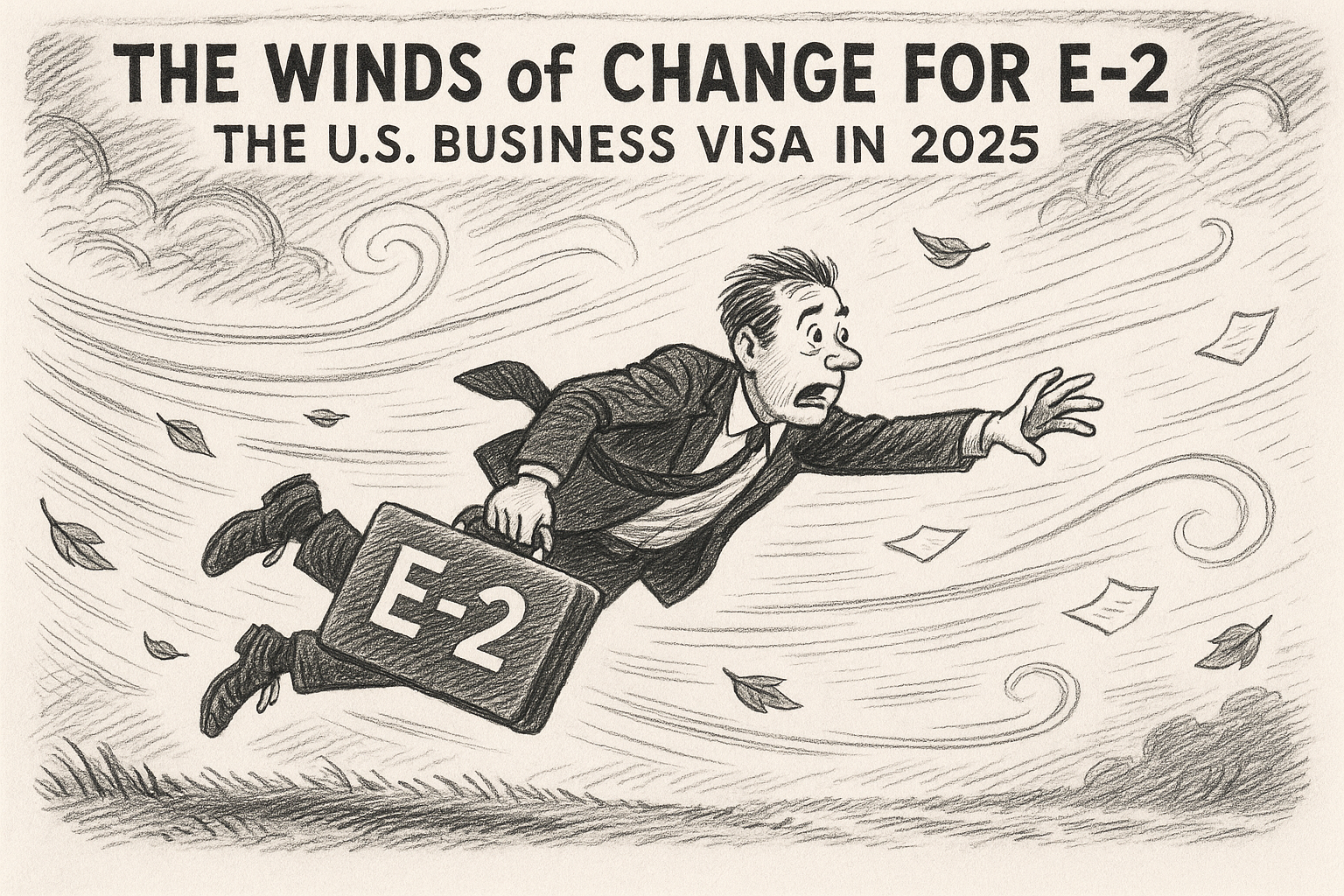
From Bush to Biden — and Back Again
The E-2 Treaty Investor visa has weathered four presidencies over the past two decades, each leaving its own imprint on how entrepreneurs enter the United States.
- George W. Bush era (2001–2009): The E-2 visa remained a steady pathway for treaty country nationals. State Department statistics show stable issuance levels, with adjudication guided by long-standing principles in the Foreign Affairs Manual (FAM), emphasizing “substantial” investment and “non-marginality” without fixed monetary thresholds 1.
- Barack Obama era (2009–2017): The program modernized administratively, but no structural changes were introduced. The FAM continued to stress proportionality between the total cost of the business and the investor’s commitment 2.
- Donald Trump era (2017–2021): While no new regulations directly targeted E-2 visas, broader immigration enforcement priorities filtered into consular practice. Applicants at some posts faced longer interviews and higher refusal rates under Section 214(b), according to State Department annual reports 3.
- Joe Biden era (2021–2025): The most notable update came in November 2021, when USCIS confirmed that E-2 spouses are considered employment-authorized incident to status, eliminating the need for a separate work permit 4. In December 2022, Congress amended the law: nationals who obtained citizenship through investment must show three years of domicile in that treaty country before applying for an E-2 visa 5.
- Trump return (2025– ): Early signals point to heightened scrutiny across several visa categories. While the E-2 has not been directly rewritten, adjudications reflect broader skepticism of low-investment applications 6.
Countries Hit the Hardest
Several treaty nations have seen access narrowed:
- Bolivia (2012): Treaty terminated, closing E-2 eligibility 7.
- Ecuador (2018): Treaty ended, with a grace period for existing investors until 2028 8.
- Citizenship-by-investment countries (post-2022): Under congressional mandate, new nationals must first establish three years of residence in their treaty country before qualifying 5.
Why Status Still Works for Some
While consular visas may be harder to secure in certain posts, E-2 status—granted through USCIS inside the United States—remains viable. Investors who can afford to remain “landlocked” while building their business can operate legally, employ staff, and rely on their spouse’s work authorization 4. The drawback is limited travel: without a consular visa stamp, departures from the U.S. typically mean forfeiting re-entry in E-2 classification.
The “Hundred-Thousand Dollar” Myth
Officially, there is no minimum investment requirement for an E-2 visa. The FAM instructs officers to apply a proportionality test: the lower the total cost of the business, the higher the investor’s percentage of funds that must be committed 1. However, applicants with very small service businesses often struggle. State Department data show consular posts frequently emphasize evidence of job creation, payroll, and real operational spending, fueling a persistent—though unofficial—belief that $100,000 is the de facto floor 3.
Industries Still Hot
Certain sectors continue to align naturally with E-2 standards and broader U.S. labor demand:
- Trucking and logistics: The Bureau of Labor Statistics (BLS) reports a continuing shortage of heavy and tractor-trailer truck drivers, creating strong conditions for E-2 applicants investing in fleets and dispatch operations 9.
- Nursing and healthcare staffing: BLS projects that registered nursing will add hundreds of thousands of openings annually through 2032, making staffing agencies and support services strong E-2 candidates 10.
- Non-emergency medical transportation (NEMT): With an aging population, demand for patient mobility services is climbing, making fleet-based ventures attractive for visa adjudicators seeking clear payroll impact 11.
The IT and Start-Up Challenge
By contrast, early-stage IT and “lean” start-ups often find it harder to prove substantiality and non-marginality. Software consultancies or app prototypes can operate with little capital and limited early hiring. Consular officers, following the FAM, may view such businesses as marginal unless entrepreneurs front-load operations—hiring staff, securing contracts, or prepaying vendor services to demonstrate scale 13.
The Road Ahead
Despite periodic turbulence, the E-2 visa continues to offer a uniquely entrepreneurial path into the U.S. market. State Department records show issuances rebounded to historic highs in 2023 and 2024 12.
For those prepared to invest, hire, and remain stateside long enough to stabilize operations, the E-2 remains a strong—if demanding—vehicle for building the American dream.
Footnotes
- U.S. Department of State, Foreign Affairs Manual (9 FAM 402.9 E Visas). ↩ ↩2 ↩3
- U.S. Department of State, E Visa Guidance under the Obama Administration. ↩
- U.S. Department of State, Visa Statistics & Annual Reports (2017–2021). ↩ ↩2 ↩3
- USCIS Policy Alert, Employment Authorization for E and L Spouses, November 2021. ↩ ↩2
- National Defense Authorization Act (NDAA) 2022, Section 5902. ↩ ↩2
- U.S. Department of State, Consular Affairs Visa Updates, 2025. ↩
- U.S. Department of State, Treaty Termination Notice – Bolivia, 2012. ↩
- U.S. Department of State, Treaty Termination Notice – Ecuador, 2018. ↩
- Bureau of Labor Statistics, Occupational Outlook Handbook – Heavy and Tractor-Trailer Truck Drivers, 2024. ↩
- Bureau of Labor Statistics, Occupational Outlook Handbook – Registered Nurses, 2024. ↩
- U.S. Department of Health & Human Services, Medicare/Medicaid Transportation Demand Data. ↩
- U.S. Department of State, Visa Statistics – E-2 Issuances, 2023–2024. ↩